Overheard at Breakfast: OSINT - image x Gmail x Gravatar profile & Base64 (TryHackMe)
Link to the CTF challenge on TryHackMe: Overheard at Breakfast
Concierge Briefing
The breakfast terrace is loud this morning, clinking cutlery, espresso machines, the usual chatter. One guest couldn't help but linger at a nearby table, seeing more of a conversation than they were meant to.
When the table's occupant stepped away for a refill, they seized the moment and grabbed a screenshot before it could disappear. Somewhere in that conversation is enough to track down an account nobody was supposed to find.
TODAY'S ITINERARY
[ ] Analyze the provided conversation for identifying details
[ ] Extract the relevant clues
[ ] Locate the hidden account
[ ] Submit the flag
OSINT
Social Media
Hashing
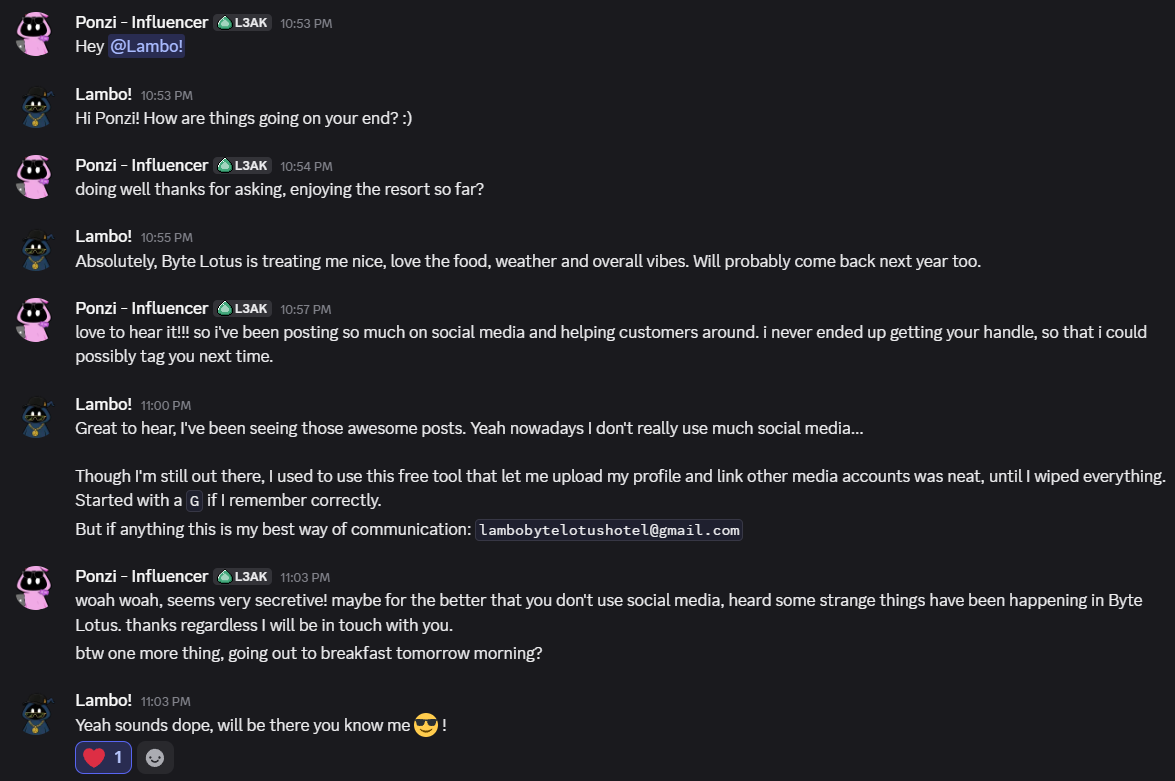
The above image was attached to the challenge. This is an OSINT challenge; we're supposed to use the screenshot to help us find any information that can lead us to the flags. From the screenshot, we can see the email and a little information about Lambo, their avatar (people tend to reuse one on different platforms), and the fact that they're visiting the resort.
From a previous OSINT challenge, I learned about this platform called epieos, where you can search emails and find some OSINT information
checked epieos
lambobytelotushotel@gmail.com2 results(7.8 seconds)Mon, 03 Aug 2026 12:40:35 GMT!Epieos logo
Google account finder will show you if the requested email is linked to a Google account and/or if the person left reviews on Google Maps.
img/profile/fake/vonneumann.jpg
Sign up
109541557676124188877
1777-04-30
Sign up
https://www.google.com/maps/contrib/109541557676124188877
https://calendar.google.com/calendar/u/0/embed?src=lambobytelotushotel@gmail.comCopy URL
https://web.archive.org/web//plus.google.com/109541557676124188877Copy URL
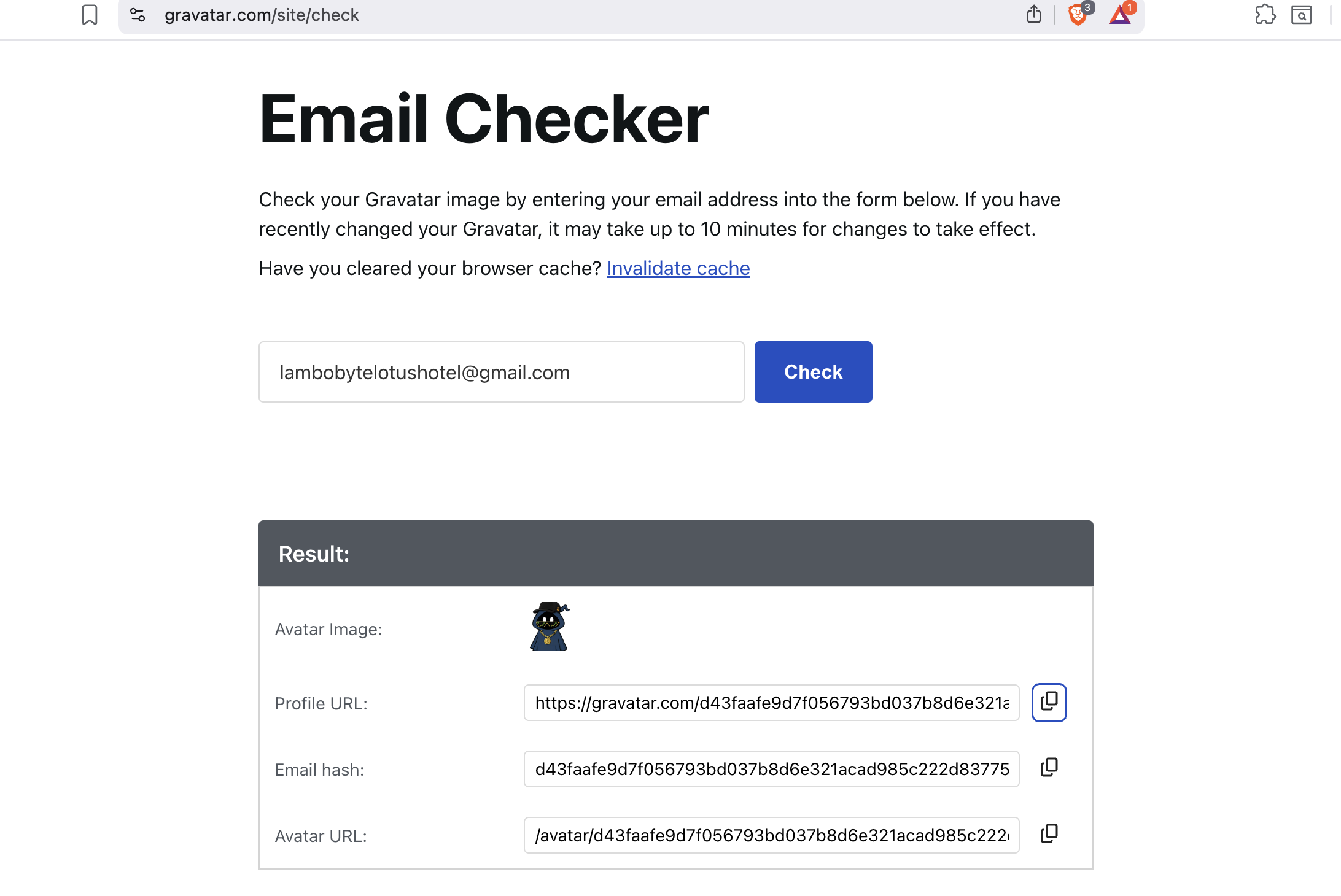
- This tool allows you to find a gravatar account linked to an email address.
img/profile/fake/euler.jpg
Sign up
314159265359
Sign up
https://example.com/longhiddenlink
Sign up
Edsger Wybe Dijkstra
Sign up
Carl Friedrich Gauss
Sign up
Leonhard Euler
Sign up
Transia
Sign up
echo -n "lambobytelotushotel@gmail.com" | md5sum
d4a5fc5d3128890778667e24617d7cc0  -

curl -s https://api.gravatar.com/3/profiles/d4a5fc5d3128890778667e24617d7cc0
{
    "errors": {
        "error": "Unsupported version"
    }
}%

curl -s https://www.gravatar.com/d4a5fc5d3128890778667e24617d7cc0.json

curl -s -o /dev/null -w "%{http_code}\n" "https://www.gravatar.com/avatar/d4a5fc5d3128890778667e24617d7cc0?d=404"
200
Conclusion
Overheard at Breakfast is a clean example of OSINT correlation through identifier reuse: no exploitation, no injection, just patient pivoting from one leaked data point (a screenshot) through multiple public services that all key off the same underlying identifier: the email address.
What the investigation demonstrates
A single email address is a surprisingly strong pivot point across unrelated services. Once
lambobytelotushotel@gmail.comwas visible in the screenshot, it became the key that unlocked multiple independent OSINT surfaces:Epieos → Google account correlation: confirmed the email is tied to an active Google account (numeric Google ID
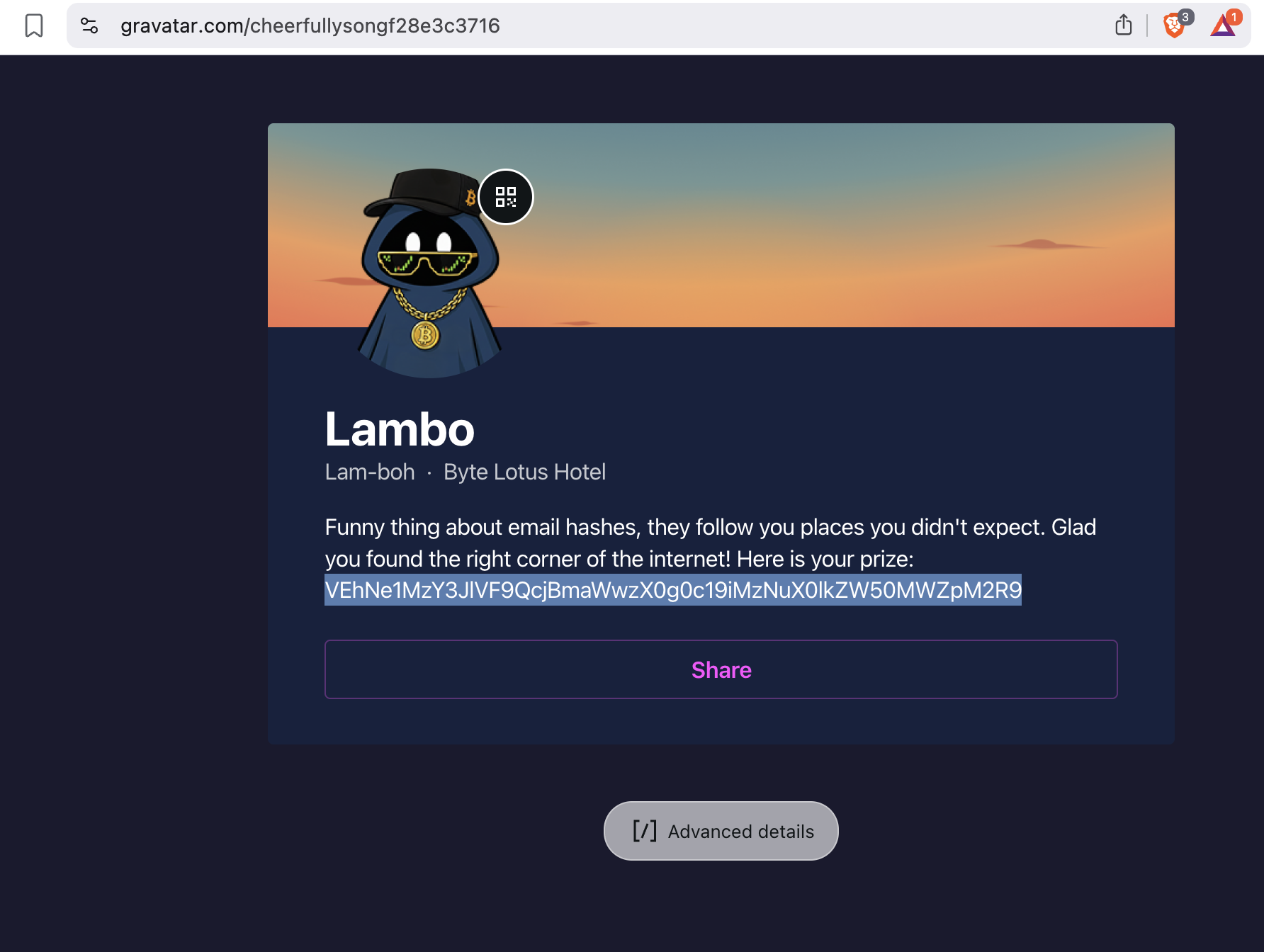
109541557676124188877), exposed a Google Maps contributor profile, and even surfaced a Wayback Machine snapshot of a defunct Google+ profile - showing that deleted platforms can still leak identifying data years later via archives.Gravatar lookup: the same email, MD5-hashed, resolves to an avatar image - Gravatar's whole design assumes the hash of your email is a safe, non-reversible identifier to expose publicly, which OSINT tooling routinely disproves in practice.
Gravatar's hash-as-identifier model is a privacy weak point, not a security control. MD5 of a known/guessed email is instant to compute (
echo -n "..." | md5sum), and Gravatar's own API confirms whether that hash has a registered account (200 OKon/avatar/<hash>?d=404means "this hash has a real avatar," not the default fallback). This turns "does this email have a Gravatar" into a simple oracle - useful for OSINT, but also a reminder that MD5-of-email is not obfuscation; it's a lookup key anyone can compute offline.API versioning matters when chaining tools. The
api.gravatar.com/3/profiles/<hash>call returned"Unsupported version"- a good practical lesson that public OSINT APIs change their versioned endpoints over time, and a failed call doesn't necessarily mean the target has no data; it can mean the wrong API version/endpoint was hit. The correct next step is checking Gravatar's current documented endpoint (their v1/v3 profile API has shifted) rather than concluding the lookup dead-ends there.Avatar reuse is a durable correlation signal. The briefing's own hint "people tend to reuse one avatar across platforms" is exactly how a defender or investigator pivots from "an email in a screenshot" to "this person's accounts elsewhere," and it's equally exactly how an attacker doing reconnaissance on a real target would work. Reverse image search on a distinctive avatar (TinEye, Google Lens, PimEyes-class tools) is normally the next move here, in addition to hash-based lookups.
Security takeaways
Screenshots leak more than intended. The entire chain started from someone glimpsing a screen over someone's shoulder ("shoulder surfing") and capturing an email address: a reminder that visible-on-screen data in public spaces (cafes, terraces, shared workspaces, video calls) is a real reconnaissance vector, not a theoretical one.
Email addresses should be treated as quasi-PII even when "just an email." A single address, once known, chains into: real name (via Google account/Maps reviews), Gravatar-hosted avatar and possibly bio/social links, and historical presence on now-defunct platforms via web archives. Anyone provisioning accounts (guest wifi portals, hotel apps, loyalty programs) should assume the email itself is enough to start building a profile of the person.
Deleted ≠ gone. The Wayback Machine snapshot of a defunct Google+ profile is the clearest example: platform shutdown doesn't remove archived exposure. Any takedown/deletion request only addresses the live platform, not third-party archives.
MD5(email) is not a privacy-preserving identifier. Any system using a hash of a well-known, guessable, or breach-leaked field (email, username) as a "safe" public key is exposed to exactly this kind of dictionary/rainbow lookup. This applies to Gravatar by design, but the same anti-pattern shows up in other systems that hash predictable inputs and assume that's sufficient obfuscation.
Loosely mapped to attacker tradecraft (MITRE ATT&CK / PRE-ATT&CK framing, since this simulates recon against a target)
T1589.002: Gather Victim Identity Information: Email Addresses; the entire chain starts here.
T1593.001: Search Open Websites/Domains: Social Media, Google Maps contributor profile, Google+ archive.
T1596.002: Search Open Technical Databases: WHOIS/Reverse lookups (adjacent), Epieos and Gravatar function as reverse-identifier lookup services in the same spirit.
For your OSINT methodology notes
Worth keeping as a repeatable pivot sequence for any email-first OSINT task:
Epieos (or similar) → check Google account linkage, Maps reviews, calendar exposure.
Gravatar hash lookup (MD5 of lowercased, trimmed email) → check for avatar/profile existence via the current API version.
Wayback Machine on any historical profile URLs surfaced above.
Reverse image search on any recovered avatar to find reused instances elsewhere.